Marine Conservation
Defending the law that saves whales and dolphins
Defending the law that saves whales and dolphins
January 16, 2026
For marine scientists, “the office” is often under water, on a research vessel, or in a laboratory. But for Brian Sharp, biologist and director of our marine mammal rescue program, one of the most effective frontlines for marine mammal protection has been Capitol Hill.
Based on Cape Cod, Massachusetts—a global hotspot for strandings—Brian leads rescue actions for marine mammals in need and oversees international response training. In June 2024, Brian and his team responded to the largest recorded dolphin stranding in the United States, when 146 Atlantic white-sided dolphins washed ashore off Wellfleet, Massachusetts. Thanks to swift action and expert coordination, 102 dolphins survived.
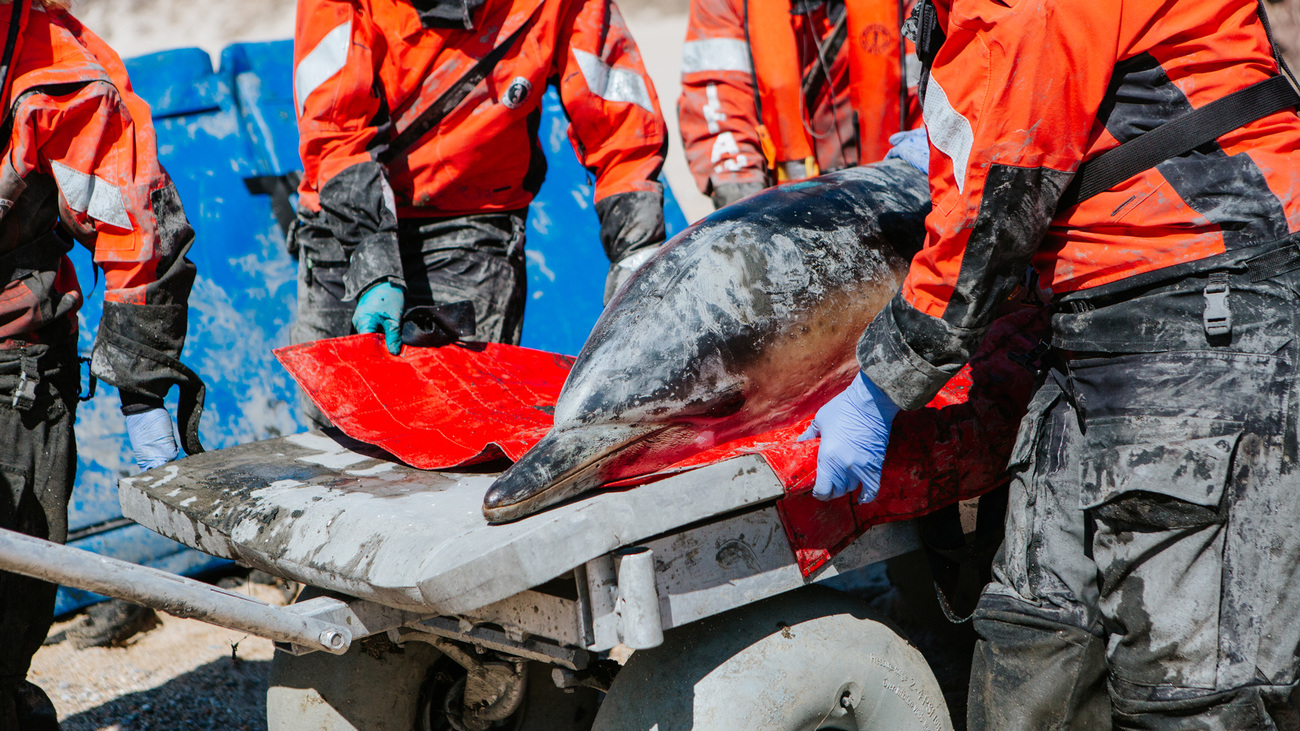
Close-up of a common dolphin being transported by cart to the release beach after being cleared by a health assessment. Photo: Andrea Spence / © IFAW, Activities conducted under a federal stranding agreement between IFAW and NMFS under the MMPA.
“When we respond to a mass stranding, every minute counts. Having the legal authority, funding, and resources to act makes the difference between life and death for these animals. In those moments, you’re not thinking about politics—you’re thinking about the one dolphin in front of you, fighting to survive.”
Yet, saving stranded marine mammals requires more than a skilled rescue team of biologists, veterinarians, and trained volunteers. Permits, funding, and protections embedded into the Marine Mammal Protection Act (MMPA)—a bedrock conservation statue—make rescue missions like this possible.
Under the MMPA, authorized rescue professionals like Brian and his team can protect a wide range of species through stranding response, disentanglement, and in some cases, rehabilitation. To join the National Marine Mammal Stranding Response Network, aquariums, non-profit organizations, and other conservation groups must obtain rescue permits and receive authorization from NOAA Fisheries to conduct rescue, research, and rehabilitation on marine mammals.
The Act also allocates funding toward marine mammal protection. A 2000 amendment established the John H. Prescott Marine Mammal Rescue Assistance Grant Program, which awards funding to rescue and stranding organizations across the country. Network partners apply annually for Prescott funding to support lifesaving intervention and rehabilitation for stranded or entangled animals. Without this funding, the capacity for rescue interventions would shrink, leading to devastating increases in animal suffering.
Beyond funding and networks, the MMPA prohibits harassment, hunting, capturing, and killing of marine mammals in most cases. These protections are what make the MMPA one of the most successful pieces of environmental legislation in the United States. Since its enactment in 1972, with bipartisan support, no marine mammal species has gone extinct in US waters.
But current efforts to roll back MMPA protections pose a grave threat to marine mammals and the dedicated professionals who protect them. In response, Brian and other experts and passionate constituents traveled to Washington, DC, to advocate for continued strong protections for marine mammals.

IFAW Program Director Brian Sharp speaks at a congressional briefing on the Marine Mammal Protection Act in Washington, DC, in September 2025. Photo: Oceana
IFAW’s work falls under two pillars—wildlife rescue and conservation. Brian’s daily work is rooted in marine mammal rescue, but on Capitol Hill he stepped into the role of conservation advocate. Over a two-day fly-in, Brian and other marine mammal professionals met with 45 congressional offices to share why the MMPA and rescue response matter. IFAW’s DC-based marine conservation team joined him to build relationships and advance conversations around marine mammal protection in the US.
Outside his many congressional meetings, Brian was one of three panelists at a congressional briefing on the MMPA, where he highlighted the Prescott Grant’s monumental impact on marine mammal populations.
“Prescott funding is essential to performing rescue efforts. There are organizations within the stranding network that are only two or three people. The absence of this funding will create gaps in the stranding network—a consequence that will only cause suffering in stranded marine mammals.”
Rescue professionals don’t typically conduct their work in the offices of senators and representatives, but proposed attacks on MMPA protections left Brian and other marine scientists with no choice but to speak up. Representative Nicholas Begich’s (R-AK) draft reauthorization would weaken critical protections and allow increased harm to marine mammals. If enacted, these changes would increase the number of strandings along all US coastlines and make it more difficult for authorized rescue groups to respond.
Weakening the MMPA will have real, catastrophic effects on whales, dolphins, and other marine mammals in US waters. The draft proposal puts these species at greater risk of decline and extinction.
At IFAW, fighting for marine mammal welfare means compelling conversations with decision makers, leading dolphins out of shallow waters, engaging coastal communities, and educating the public so that we all can act as advocates for marine mammals. Together, rescue and conservation efforts work in tandem to build a healthier, more resilient ocean.
Show your support for the MMPA and marine mammals by signing the petition urging lawmakers to reject these changes.
Related content
every problem has a solution, every solution needs support.
The problems we face are urgent, complicated, and resistant to change. Real solutions demand creativity, hard work, and involvement from people like you.