Landscape Conservation
Discover the four layers of the forest—and the animals living in it
Discover the four layers of the forest—and the animals living in it
December 17, 2025
Around the world, forests provide habitats for a wide variety of animals. Many of the world’s forests are the most biodiverse places on Earth. Our forests contain 80% of amphibian species, 75% of bird species, and 68% of all mammal species.
Forests make great habitats because they provide both food and shelter in the same place. Animals that live in the forest can make their shelters here, including in tree branches, tree hollows, shrubs, and bushes, among leaves, or in the ground.
For prey animals in the forest, these habitats can provide camouflage from predator species and make it easier for them to sneak up on their prey. Forests also give animals spaces to breed, nest, and take shelter from harsh weather.
In addition to serving as safe havens for so many animals, forests provide crucial benefits to the environment. Forests create water reservoirs, protect soil, filter air, and produce oxygen.
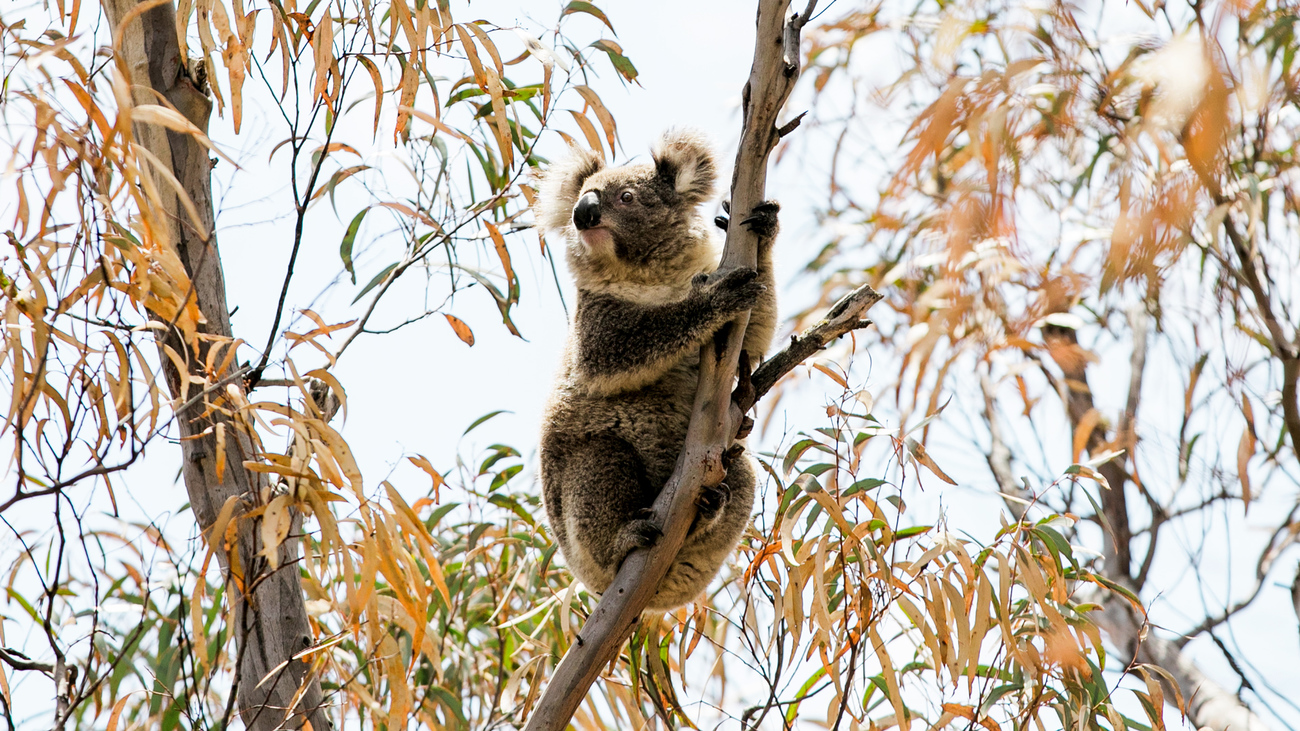
A koala sighted in a tree during the IFAW team's "black walk" in the Snowy Mountains outside Cooma, New South Wales, Australia. Photo: Stacey Hedman / © IFAW
Sadly, these vital habitats are under threat. That’s why landscape conservation is such a big part of what we do here at IFAW. Working with partners around the world, we’re striving to improve landscape protection and restore damaged habitats, so our forests can continue to provide a home for a diverse range of forest animals.
But what kind of animals live in the forest? That all depends on which part of the forest you’re looking at. We can split the forest into four distinct layers. In each layer, you find a different collection of forest animals. Let’s take a closer look.
What are the layers of the forest?
Like a four-storey building, a forest is divided into layers. Generally, scientists divide forests into four basic layers, but these can be broken down into more layers in some cases. Though they’re all connected, these distinct layers receive different levels of sunlight and host different types of forest animals. Common terminology for the four layers of the forest describes the forest floor, the understory, the canopy, and the emergent layer.
Let’s break down these four layers and take a closer look at the animals that live in the forest, starting with the forest floor.
Forest floor
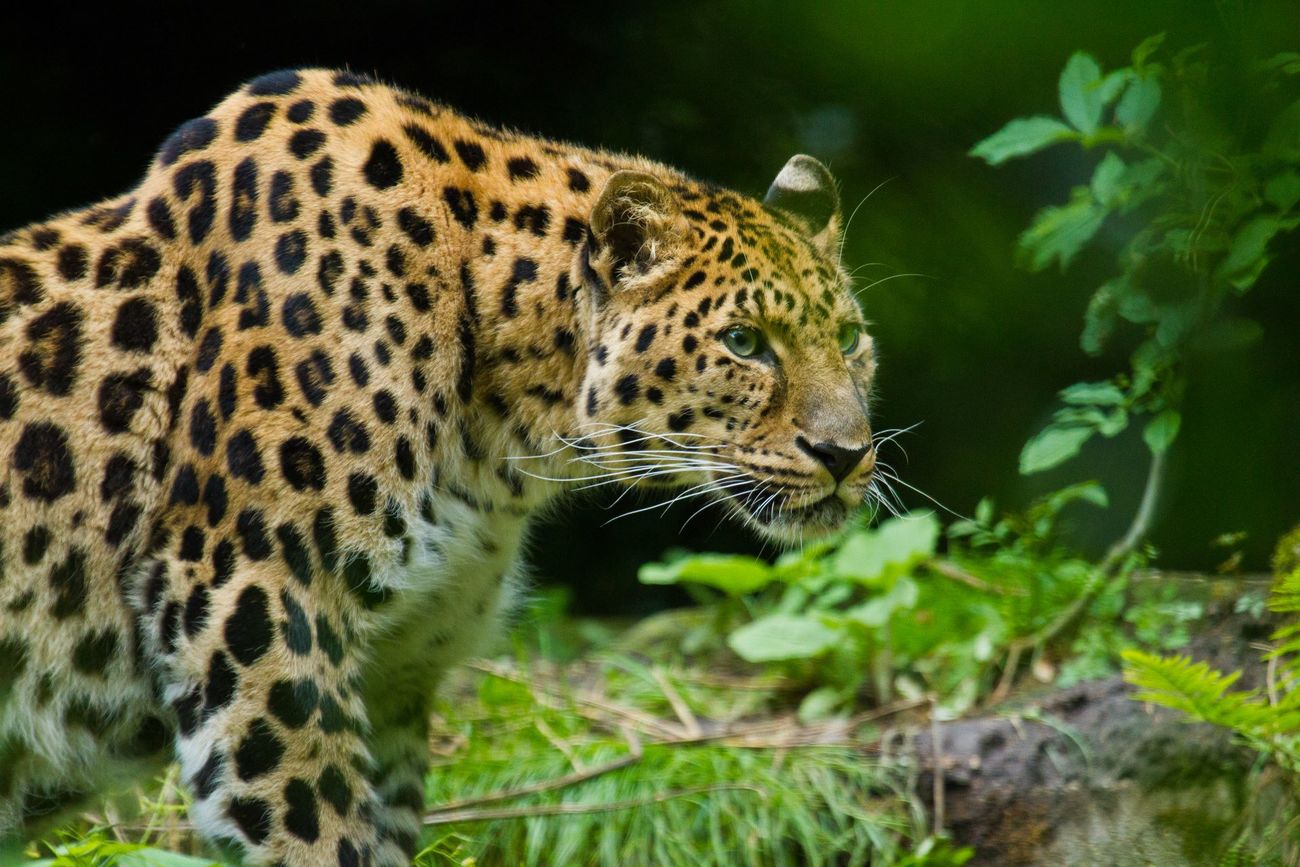
An Amur leopard in a forest.
Right at the bottom of the forest, there’s the forest floor. Let’s take a look at this environment and some of the forest floor animals you can find there.
What is the forest floor?
The forest floor is the lowest layer of the forest. This is often the darkest and most humid layer of a forest, and it receives the least amount of sunlight. The forest floor contains leaves, twigs, branches, seeds, and fruits that fall from trees. Helped along by bacteria and fungi, these materials decompose, making the forest floor quite rich in nutrients and creating healthy soil.
Animals on the forest floor
Elephants
Large terrestrial animals are most often found on the forest floor, as they are too large to live in trees. In the forests of Central and West Africa, you may find African forest elephants (Loxodonta cyclotis) roaming the forest floor. As they do so, they help unearth underground water sources, bring food sources closer to the ground, and clear vegetation, allowing smaller plants to access sunlight.
Sadly, in 2025, African forest elephants are classed as critically endangered and have a decreasing population.
Amur leopards
Another animal that lives on the forest floor is the Amur leopard (Panthera pardus orientalis). These big cats can be found in the forests of eastern Russia and northern China. Though they sometimes rest in trees, they tend to roam around on the forest floor. Using the cover of vegetation and darkness, they stalk and catch smaller animals as their prey. Despite population growth in recent years, there are just 130 Amur leopards left in the wild in 2025.
Giant anteaters
An inhabitant of the forest floor in South America is the giant anteater (Myrmecophaga tridactyla). These animals have long, sticky tongues and tube-shaped snouts that allow them to dig for insects in the ground.
Their unique feeding behaviours not only help control ant and termite populations but also aerate the soil and promote nutrient cycling on the forest floor. These animals play a crucial role in their forest habitat, but in 2025, they are currently classed as vulnerable to extinction and have a decreasing population.
Gorillas
Though they can also climb trees, gorillas primarily live on the forest floor as well. They feed on fruit, stems, roots, vines, herbs, tree bark, and grasses—anything they can reach. As they inhabit the Congo rainforest, gorillas often have to seek shelter from the rain. They may simply sit still on the ground underneath trees, or they will find a cave.
Other forest floor animals
Many smaller animals spend time on the forest floor, too, including rodents, frogs, rabbits, and ground-dwelling birds.
Understory
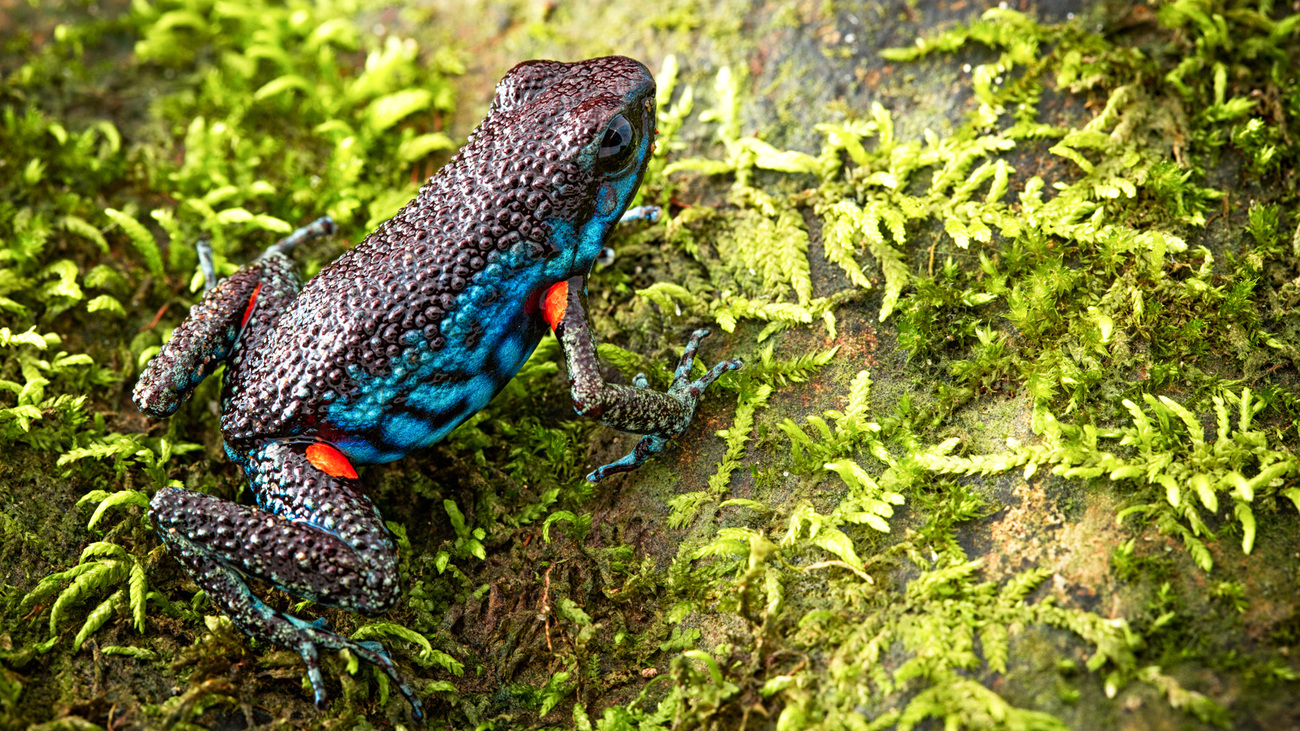
Niceforo's poison frog in Colombia.
Now onto the forest understory. What is the understory, and what animals live in the understory layer of a forest?
What is the understory of a forest?
Also called the strata, the understory of a forest is the next layer above the forest floor. It consists of shrubs, herbaceous plants, ferns, and young trees. These plants are well adapted to areas receiving low sunlight. Mosses, lichens, and fungi cover many of the tree trunks and branches in the understory, as do climbing plants and vines. Though it receives more sunlight than the forest floor, the understory is still a relatively dark environment.
Animals in the forest understory
Insects
The forest understory hosts flying insects, such as mosquitoes, bees, beetles, and butterflies. However, many larger animals reside in the understory, too.
Reptiles and amphibians
Snakes like boa constrictors wind their way around tree trunks, blending into the bark. Small amphibians like poison dart frogs climb stems and leaves after laying their eggs in a nearby stream. Of the 200 living poison dart frog species, more than half are considered threatened.
The La Planada poison frog (Paruwrobates andinus), Collins’ poison frog (Andinobates abditus), and the green poison frog (Andinobates viridis) all have fewer than 50 remaining individuals and are at serious risk of extinction in 2025.
Birds and small mammals
Some animals hide in hollowed-out trees. These include owls, parrots, bats, porcupines, squirrels, and raccoons. In Australia, tree hollows also serve as homes for possums, gliders, and antechinus.
Jaguars
Though they also roam on the forest floor, jaguars (Panthera onca) are frequent residents of the understory in forests of South America, lounging in lower branches. These rainforest animals have spotted patterns that mimic the shadows of leaves in their surroundings, camouflaging them from their prey.
Canopy
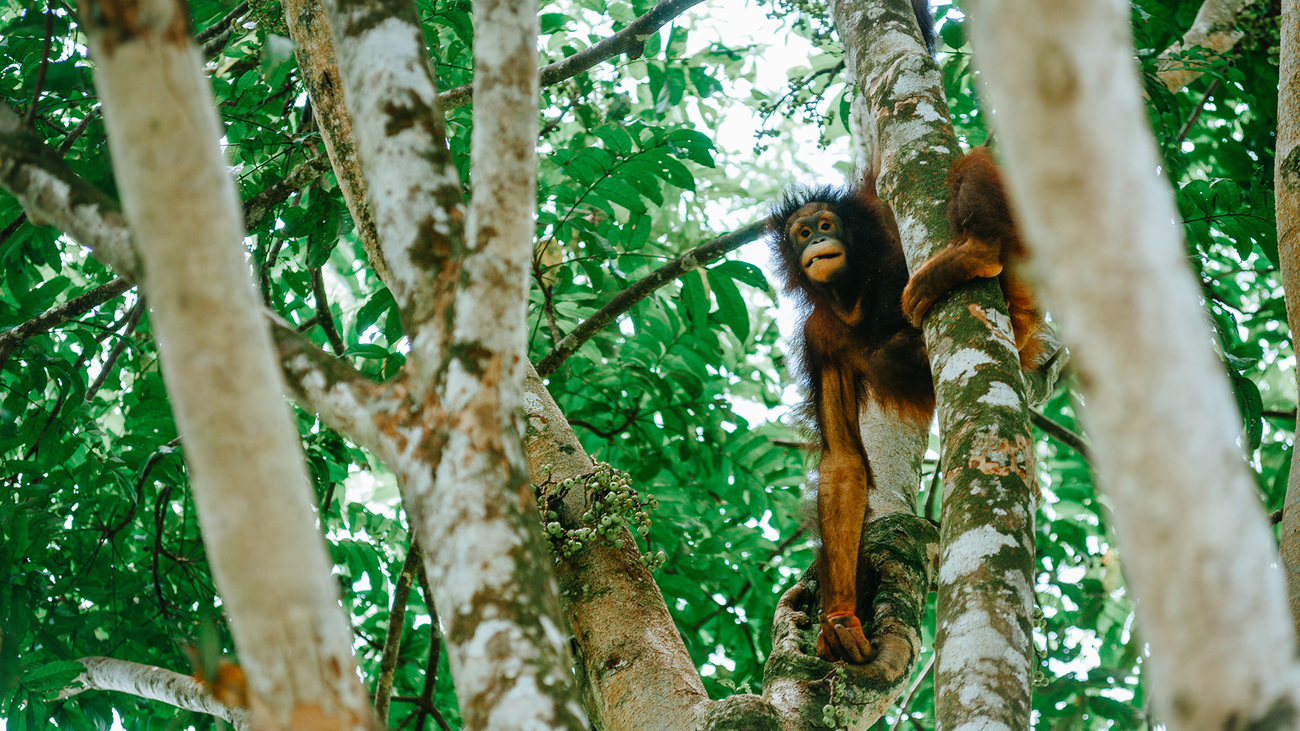
Mungil the orangutan climbing in the trees on Dalwood-Wylie Island, Borneo, Indonesia. Photo: Hardi Baktiantoro / © IFAW
One of the most beautiful layers of the forest is the canopy, which receives lots of sunlight. Let’s take a look at what this environment is like and which canopy animals live there.
What is a canopy in a forest?
Above the understory is the third layer, the canopy, which typically contains the majority of the animals living in the forest. Standing dozens to over a hundred feet above the ground, the canopy consists of overlapping tall trees that act as a roof over the entire forest.
Canopy layer animals
Animals in the canopy of the rainforest are typically good at climbing, gliding, and flying. The canopy is rich with fruits and nuts, which means plant-eating animals can thrive there. Many apes and monkeys inhabit the canopy, as they are capable of swinging across high tree branches.
Apes
In Southeast Asia, you might find bright orange orangutans climbing high above you. Forest canopies in South and Southeast Asia also host gibbons, known as lesser apes, whose long, flexible arms make them skilled acrobats.
Slow lorises
The slow loris, the world’s only venomous primate, is another animal of the canopy. Slow loris species are found in Southeast Asia, where they serve as occasional prey for orangutans as well as snakes and eagles. These small mammals consume nectar and transfer pollen between flowers. They also eat fruit and spread seeds through their faeces.
Javan leaf monkeys
In the tallest forests of Java, Indonesia, you may find Javan leaf monkeys (Presbytis comata), who prefer the middle and highest parts of the canopy. They feed primarily on fruits and seeds, contributing to the continuous pruning of trees, which helps sunlight reach the forest floor and enables the growth of new plants.
In 2025, the Javan leaf monkey is listed as vulnerable to extinction, and there are thought to be just 5,500 mature individuals left in the wild.
Koalas
In the eucalyptus forests of Australia, you’ll find koalas (Phascolarctos cinereus) high up in trees. These unique marsupials consume up to 1.3 kilograms (2.9 pounds) of leaves every day, but they are very sedentary animals, spending 18 to 22 hours a day sleeping.
Like the Javan leaf monkey, these forest animals are also vulnerable to extinction and have a decreasing population in 2025.
Tree kangaroos
In Australia and New Guinea, you’ll also find the elusive tree kangaroos. There are 14 species of tree kangaroo, all under one metre tall. They all have long, bushy tails that they push against tree trunks for balance and stability. They also have long, muscular arms and curved, sharp claws that are perfect for climbing.
Spider monkeys
Spider monkeys inhabit the canopies of Central and South America, eating fruit and dispersing seeds through their droppings. Their feeding and movements are crucial in maintaining plant life in tropical forests. Their long, prehensile tails function as a fifth limb and make them extremely adept at swinging from tree to tree.
Emergent layer
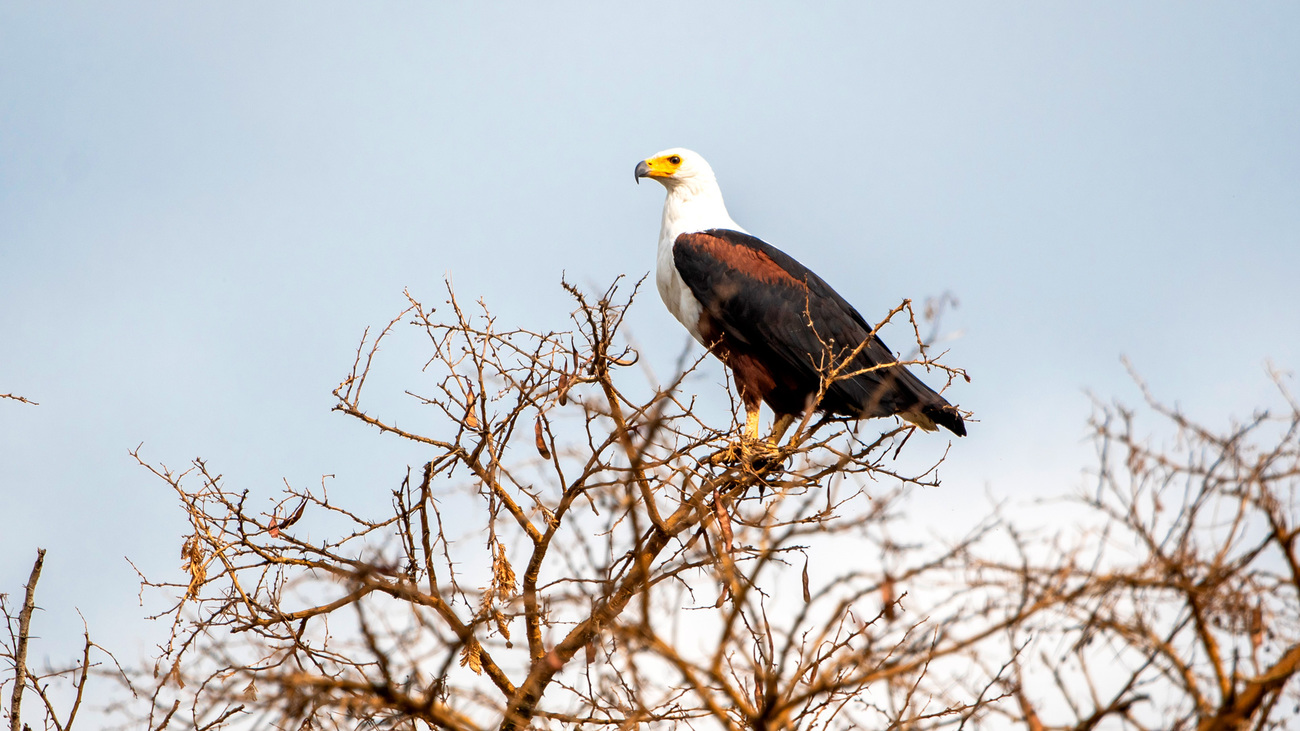
An African fish eagle perched in the very top of a tree in Queen Elizabeth National Park, Uganda. Photo: Paolo Torchio / © IFAW
Finally, let’s look at the emergent layer of the forest. Here’s what life is like at the top of the tallest trees, along with a few of the animals that live in the emergent layer.
What is the emergent layer of a forest?
The uppermost layer of the forest is called the emergent layer. This layer consists of the tops of the tallest trees in the forest, which poke out into the sky above the others. These trees might reach up to 60 metres (200 feet) tall.
This layer tends to experience the most extreme weather conditions. It receives the most sunlight—and direct heat—making it drier than the lower layers. Rain, snow, and wind are also felt most directly by this layer, as are cold temperatures at night.
To adapt to these rough conditions, trees in the emergent layer have evolved to have small, tough leaves coated in thick wax. Many of the branches in this layer are the thinnest, which means that heavier forest animals cannot live there. It is primarily flying and gliding animals that inhabit the emergent layer.
Emergent layer animals
Birds of prey
Birds of prey are often found in the emergent layer. A few examples are the harpy eagle of Central and South America, the bald eagle of North America, the African fish eagle, and the white-bellied sea eagle of Australia and southern Asia. Bald eagles tend to build their nests high up in mature, old-growth trees. This gives them a great view of the surrounding area, but it also means their nests must withstand strong winds, snow, and rain.
Parrots
Parrots are another animal in the emergent layer. Species include the scarlet macaw of Central and South America and Australia’s cockatoos.
Small mammals, monkeys, and insects
Some bats, gliders, insects, and monkeys also reside in the emergent layer. As these trees are spaced further apart from one another than the trees of the canopy, animals that can’t fly have a more difficult time moving around in this layer, and prey animals have less cover here from predators.
What threats do forest animals face?
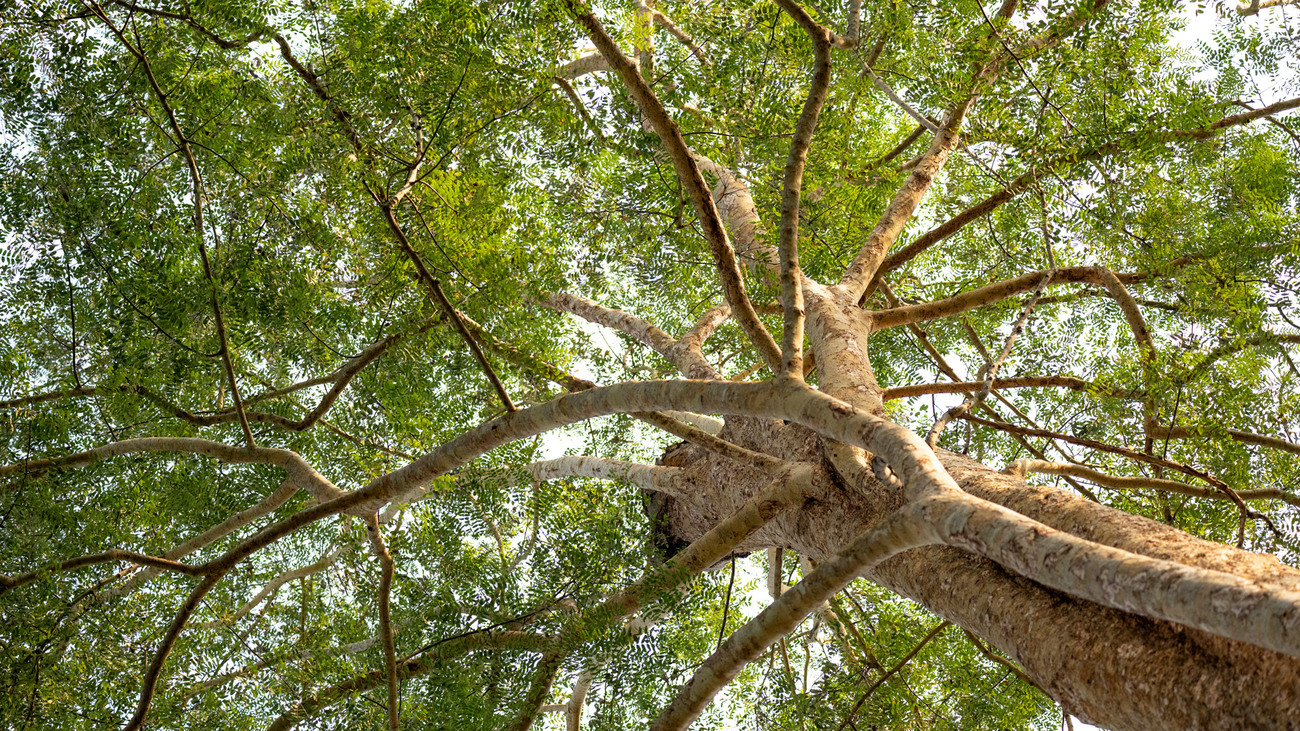
Tree seen from below in Kaziranga National Park, Assam, India. Photo: © Lara Jackson
Forest animals are unfortunately threatened by a number of issues, primarily caused by humans.
Deforestation
Deforestation is a major threat. The world lost 296,000 square kilometres (29.6 million hectares) of tree cover in 2024. That’s roughly the area of the Philippines or Italy.
Though logging is one root cause, agriculture is one of the biggest culprits—clearance of land for agriculture accounts for 80% of tropical forest loss.
Climate change
The loss of forests directly fuels the climate crisis. Without forests, our planet’s ecosystems don’t have the same capability to convert carbon dioxide to oxygen.
As climate change exacerbates, it will continue to degrade forest habitat, causing fires, floods, increased temperatures, and unpredictable severe weather events.
Biodiversity loss
Biodiversity loss is an increasingly pressing issue. If we lose animals like elephants, entire ecosystems could collapse. And without animals, our forests won’t stay healthy.
How IFAW is helping animals in the forest
IFAW is working around the world to combat these threats to forest animals and develop innovative, sustainable solutions.
In Zambia, which loses an estimated 79,000 to 150,000 hectares of forest every year, we supported an initiative to plant 3.3 million trees in Zambia’s Eastern Province. This region is a critical habitat for elephants, buffaloes, kudus, and impalas.
These small trees are helping farmers restore soil nutrients and bring high crop yields, without having to expand farmland and encroach further on wildlife habitats.
In South America, to tackle the illegal wildlife trade and protect jaguars, we worked to improve protection of the jaguar’s forest habitats, mobilise the public and policymakers, and support law enforcement to better detect, investigate, and prosecute wildlife crime.
In Australia, we’re working with partners, the local community, and landowners to restore a wildlife corridor in New South Wales as part of our Northern Rivers project. We’re ensuring that rescued koalas and their future generations have a secure habitat and can thrive.
In China, forest-dwelling Asian elephants are losing their habitat and having to venture closer to human settlements. This is leading to increased instances of human-elephant conflict. To combat this issue, IFAW launched the Asian Elephant Protection (AEP) project. For more than 20 years, the project has been promoting peaceful human-elephant coexistence with the help of elephant monitoring systems, ranger networks, and community engagement initiatives.
Learn more about our work by visiting our projects page.
Related content
every problem has a solution, every solution needs support.
The problems we face are urgent, complicated, and resistant to change. Real solutions demand creativity, hard work, and involvement from people like you.